
The Creative System Blueprint
A practical framework for turning business challenges into structured, AI-assisted creative systems—from insight and ideation through production, testing, learning, and scalable delivery.
The goal is not to automate creativity. It is to create a better system around it—one that helps teams move faster while protecting judgment, quality, brand consistency, and the human decisions that make the work valuable.
Creative work becomes more powerful when the system behind it is intentional.
The Creative System Blueprint organizes the full creative lifecycle into seven connected layers. Each layer has a different role, but all seven work together to create a repeatable path from business challenge to creative output and continuous improvement.
Understand the audience, brand, context, and objective.
Turn insight into creative directions worth exploring.
Produce controlled creative variations and assets.
Coordinate tools, people, approvals, and production.
Compare creative directions against defined objectives.
Turn outcomes into reusable creative intelligence.
Organize, govern, and deliver creative at scale.
The goal is not automation for automation’s sake.
The goal is to give creative teams a clearer system for exploring ideas quickly while preserving judgment, brand consistency, quality, accountability, and the human decisions that make the work valuable.
Start with reality, not prompts.
Before any AI generation begins, the system aligns the business objective, audience, brand context, existing signals, and creative constraints.
Business Context
Creative Signals
Creative Direction
Output: an informed creative starting point.
The Insight Layer transforms scattered information into a focused creative brief and a small set of meaningful hypotheses that guide what happens next.
Explore broadly. Decide deliberately.
AI dramatically increases the number of directions a team can explore. The opportunity is not simply to make more—it is to explore more intelligently and identify the ideas worth developing.
Diverge
Explore distinct concepts, narratives, visual territories, formats, and experiences.
Structure
Turn promising directions into clear creative systems, recipes, style logic, and production guidance.
Select
Evaluate ideas based on brand fit, originality, feasibility, usefulness, and potential impact.
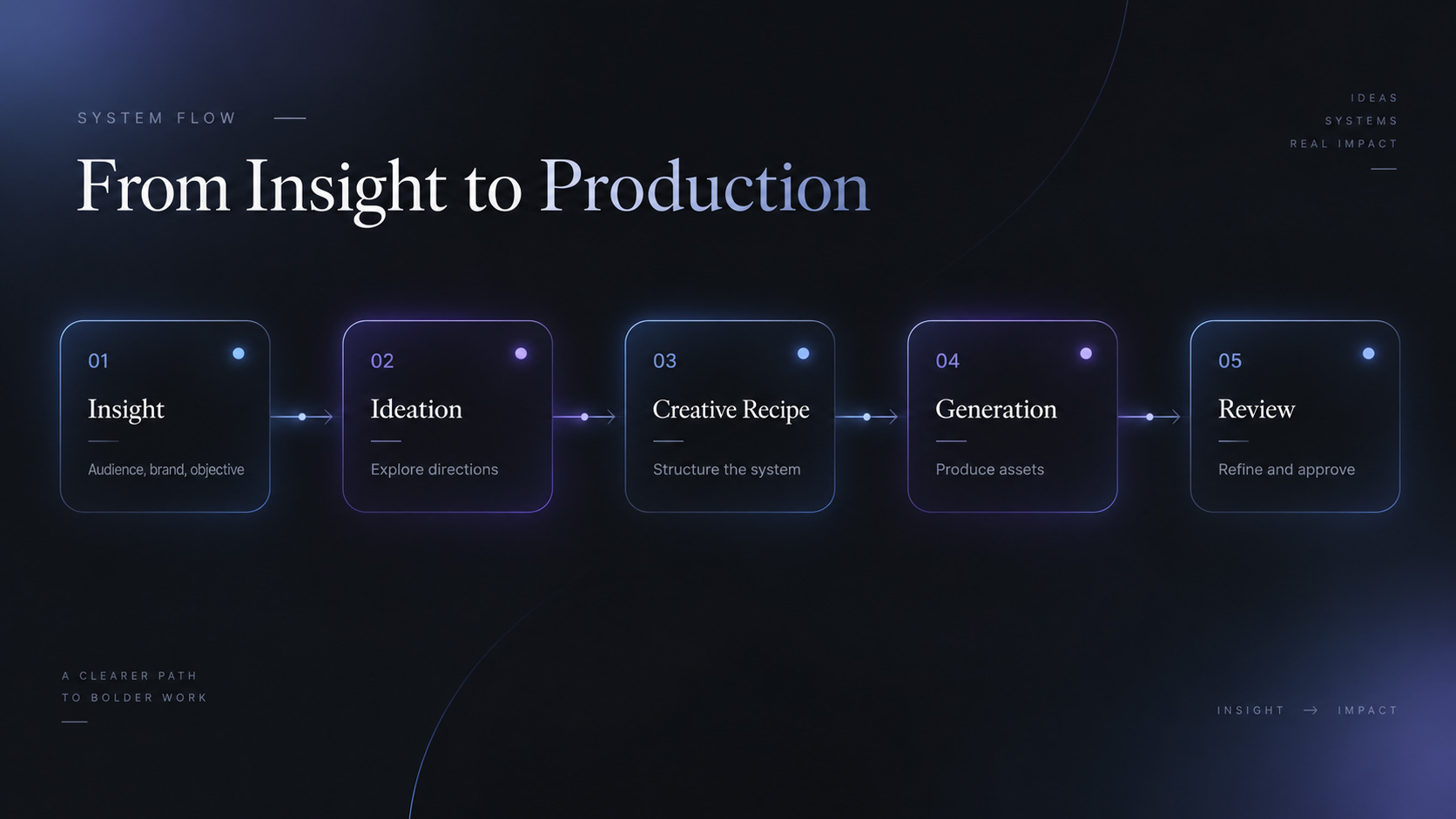
Generate with intention.
AI generation becomes more valuable when it is treated as a production discipline rather than an isolated prompting exercise. Creative direction, continuity, quality standards, and format requirements stay consistent across every output.
Creative Recipes
Define the idea, mood, visual language, camera behavior, continuity, format, and creative constraints.
Production Profiles
Adapt the work for different channels, markets, platforms, and environments without losing the core idea.
Structured Asset Production
Keep versions organized so teams can review, refine, compare, and repurpose work efficiently.
Connect the creative workflow.
The Orchestration Layer turns individual creative activities into a connected production system. It coordinates briefs, creative direction, AI-assisted production, human review, refinement, approval, and delivery.
Business need, direction, and constraints.
Concepts, recipes, formats, and requirements.
Human-led and AI-assisted execution.
Creative, brand, technical, and legal checks.
Improve promising directions with intention.
Final stakeholder review and selection.
Ready for channels, teams, and platforms.
Human Judgment
Creative direction and approval remain deliberate human decisions.
System Consistency
Shared standards keep work aligned across teams, formats, and iterations.
Flexible Technology
Tools can change without requiring the underlying creative framework to be rebuilt.
Treat creative decisions as questions worth testing.
Testing works best when it answers a real creative question. Instead of measuring everything, the system isolates meaningful differences and evaluates them against clearly defined objectives.
Define the Question
What creative choice are we trying to understand?
Compare Fairly
Keep the context stable so differences remain meaningful.
Make a Decision
Use the evidence to refine the work or guide the next creative question.
Testing supports judgment. It does not replace it.
Performance signals are interpreted alongside brand context, creative quality, audience behavior, and the purpose of the work.
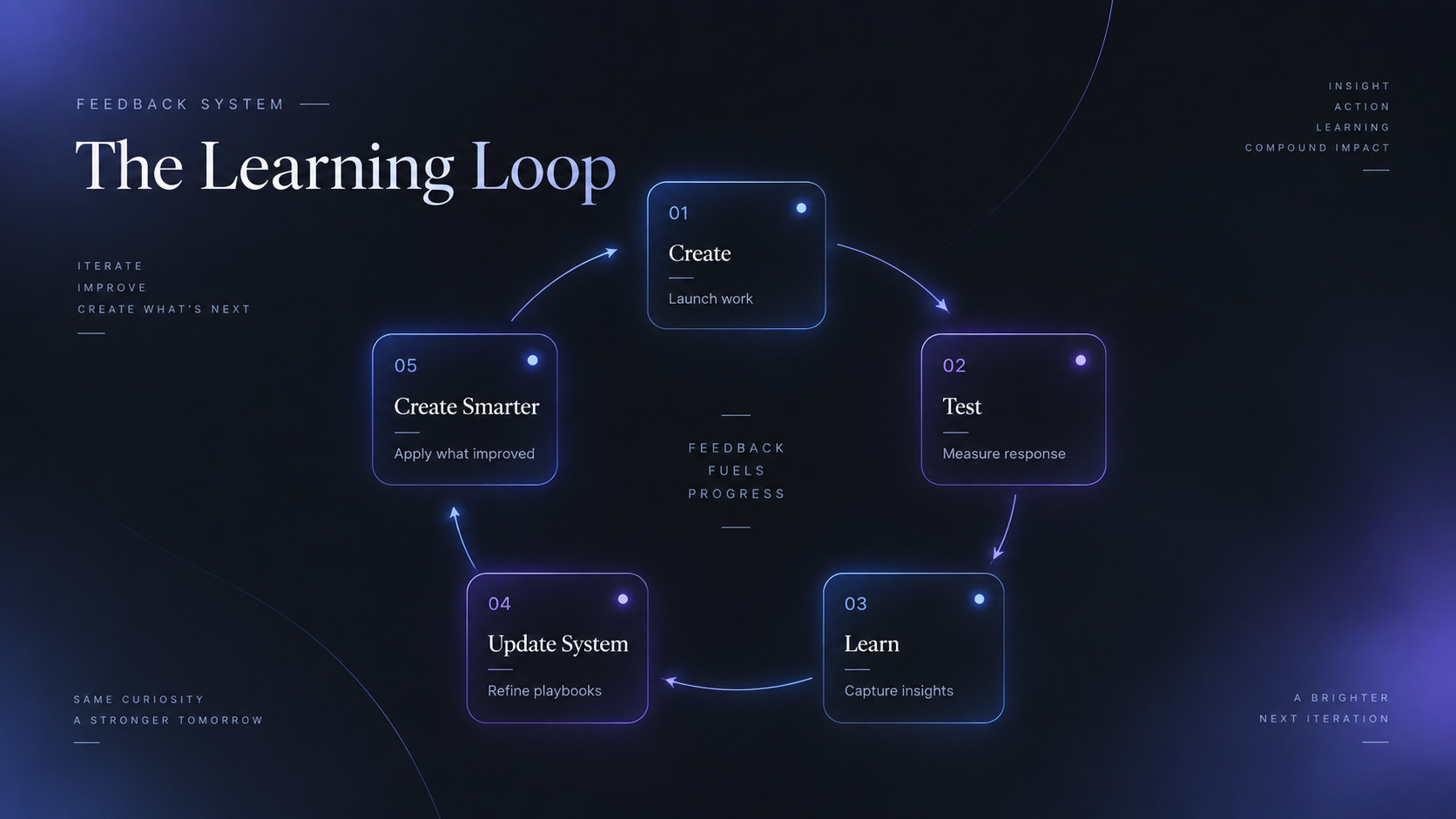
Every project should make the next project smarter.
Creative knowledge should not disappear when a campaign ends. The Learning Loop captures useful patterns, production lessons, audience response, and creative outcomes so future projects can start from a stronger position.
Capture What Worked
Update the System
Creative Intelligence
Over time, the organization builds a reusable knowledge layer around what has been attempted, what has been learned, and where future opportunity exists.
Creative value continues after the final export.
The final layer makes creative work easier to locate, understand, govern, reuse, and distribute. Strong asset operations turn completed work into an organized resource instead of a forgotten file.
Organize
Govern
Deliver
The system ends where the next project begins.
Well-organized assets and captured learning become inputs for future creative work, completing the feedback loop between production and organizational intelligence.
The technology changes. The principles remain.
Tools should respond to a clearly understood creative problem.
Automation should reduce repetitive work while protecting the decisions that require taste, context, and experience.
A strong system creates recognizable quality without eliminating experimentation.
Testing matters when the learning feeds back into the creative process.
The framework should survive changes in models, platforms, production software, and technology.